Neurofeedback for ADHD: What the Research Says and What to Expect at Marietta Brain Health
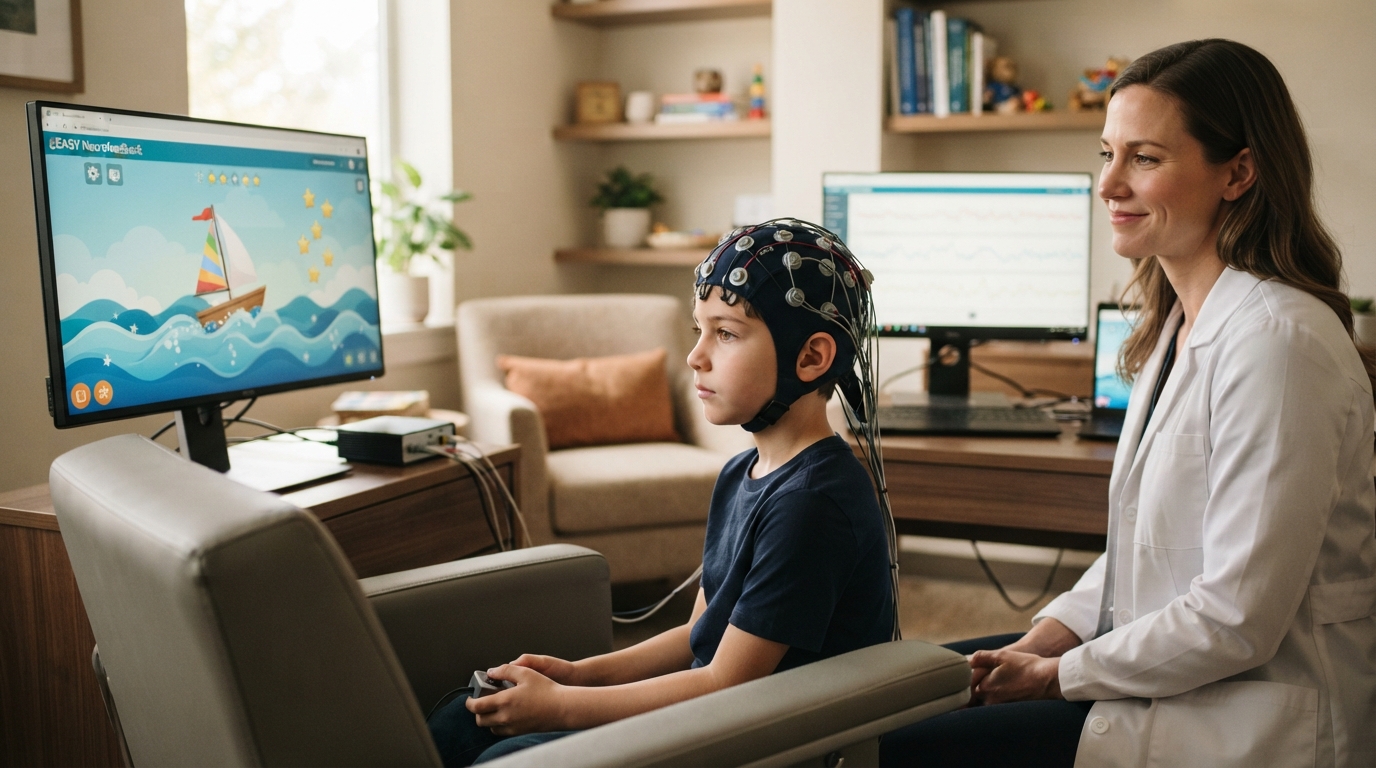
If you're a parent researching options for a child with ADHD — or an adult who's tried medication and still feels like something's missing — you've probably come across neurofeedback. It's one of the most talked-about non-medication approaches for ADHD, and also one of the most misunderstood. Here's a clear, honest look at what neurofeedback is, what current research actually shows, and what the process looks like at Marietta Brain Health.
What Is Neurofeedback?
Neurofeedback (also called EEG biofeedback) is a training process that shows a person real-time information about their own brain activity, usually through a screen or sound cues. Over repeated sessions, the goal is to help the brain learn to shift toward patterns associated with better focus and self-regulation — similar in concept to how physical therapy retrains muscles, but for the brain's electrical activity instead.
It's non-invasive, medication-free, and typically involves sitting comfortably while sensors placed on the scalp read brainwave activity. There's no pain involved, and most people describe it as similar to watching a video or playing a simple game.
What Does the Research Actually Show?
This is where we want to be straightforward with you, because ADHD families deserve real information, not marketing promises.
The evidence on neurofeedback for ADHD is mixed, and that's worth saying plainly. A large 2024 meta-analysis published in JAMA Psychiatry, pooling 38 randomized controlled trials and over 2,400 participants, found that when outcomes were rated by evaluators who didn't know which treatment a participant received, neurofeedback did not show a statistically significant reduction in core ADHD symptoms compared to control conditions.
At the same time, other recent reviews tell a more encouraging story in specific areas. A 2025 systematic review and meta-analysis in Scientific Reports found meaningful benefits for executive function — the skills involved in planning, working memory, and impulse control — in children with ADHD who completed neurofeedback training. Other research has looked at neurofeedback as an add-on to medication rather than a replacement, with some studies suggesting it may support outcomes when combined with existing treatment rather than used alone.
The Honest Summary
Neurofeedback is not a guaranteed fix, and it is not likely to work identically for everyone. But it's also not fringe science — it's an active, ongoing area of clinical research, and many individuals and families report real, meaningful improvements in daily functioning, even where large-group blinded trials show mixed statistical results.
This is exactly why an individualized approach matters more than a one-size-fits-all program.
Why Families Still Consider It
For many people, neurofeedback isn't about replacing medication or therapy — it's about adding another tool, especially for those who've had side effects from medication, who want a non-pharmaceutical option, or who want to address attention and self-regulation from a different angle alongside their existing care plan.
What to Expect at Marietta Brain Health
We don't run a one-size-fits-all protocol. Every client starts with a full assessment to understand their specific patterns before any training begins. From there, we build a personalized plan, track progress over time using objective measures, and adjust the approach based on how each individual is actually responding — not a generic template applied to everyone who walks through the door.
If you're weighing neurofeedback for yourself or your child, the best next step is a conversation, not a guess. We're happy to walk you through what an individualized assessment looks like and answer any questions about whether this approach makes sense for your specific situation.
References
- Westwood SJ, Aggensteiner PM, Kaiser A, et al. Neurofeedback for Attention-Deficit/Hyperactivity Disorder: A Systematic Review and Meta-Analysis. JAMA Psychiatry. 2025;82(2):118-129.
- Zhong X, Yuan X, Dai Y, Zhang X, Jiang C. Neurofeedback training for executive function in ADHD children: a systematic review and meta-analysis. Scientific Reports. 2025;15:28148.
- Lin FL, Sun CK, Cheng YS, et al. Additive effects of EEG neurofeedback on medications for ADHD: a systematic review and meta-analysis. Scientific Reports. 2022.
- Wu et al. Comparative Efficacy of Neurofeedback Interventions for Attention-Deficit/Hyperactivity Disorder in Children: A Network Meta-Analysis. Brain and Behavior. 2024.
Ready to Optimize Your Brain?
Schedule a free consultation to discuss how our drug-free neurofeedback therapy can help you achieve your goals.
Book Free Consult